Design Sprint workshop
From stuck to validated, in a week
A Design Sprint is the fastest way to answer your team's biggest product question without building the wrong thing first. In three to five focused days we map the problem, generate competing solutions, choose a direction, build a realistic prototype, and test it with real users. You finish the week with evidence instead of assumptions.
Facilitated end-to-end by Corissa Bowman, on-site anywhere in the US or fully remote
When a sprint is the right call
Sprints work when the stakes are high and the question is specific. They are the right tool if:
- You're launching something new and want to validate the concept before committing to a full build cycle
- You're stuck in analysis paralysis and need a structured process to align the team and move forward
- You have a hard decision to make and want real user feedback before choosing a direction
- Your team is misaligned and needs a shared process to surface assumptions and build consensus fast
- You work in a complex or regulated domain and need to move on a product decision without endless committee cycles
- You're a Colorado or Denver team looking for an experienced local facilitator who can run an on-site sprint without travel delays
Every sprint is tailored to your challenge, industry, and working style. No prior sprint experience is required from anyone on the team.
Five phases, one focused week
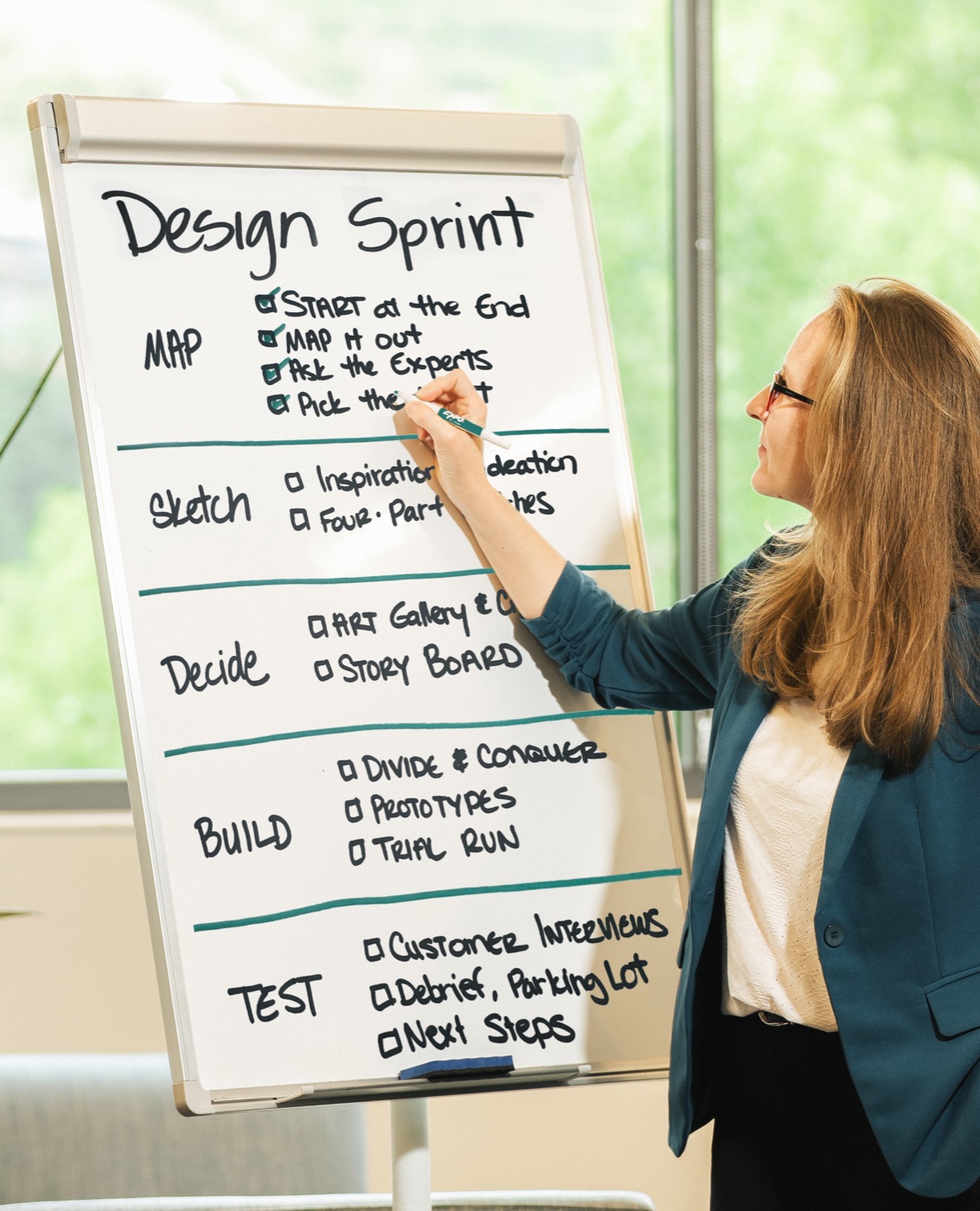
The week follows the Design Sprint structure, compressed or expanded to fit the question. I run every session so your team can stay in the problem instead of running the process.
Day 1: map
- Start at the end and agree on the long-term goal
- Map the problem and the people in it
- Ask the experts inside your organization
- Pick the target for the week
Day 2: sketch
- Gather inspiration from inside and outside your market
- Everyone sketches a competing solution using the four-part method
Day 3: decide
- Review every sketch in a silent art-gallery critique
- Choose a direction with a structured vote
- Storyboard the prototype step by step
Day 4: build
- Divide the work and build a realistic prototype
- Write the interview script
- Trial run before the customers arrive
Day 5: test
- Five one-on-one customer interviews
- Team observes and captures patterns in real time
- Debrief, parking lot, and next steps
What's included
- Full facilitation. I lead every session, keep the process moving, and handle the moments where group dynamics or internal politics threaten to stall progress.
- Sprint materials. All workshop materials, templates, and supplies. Nothing for your team to prep in advance beyond a short brief and a kick-off call.
- Customer testing. Five real user interviews on the final day, with structured debrief and synthesis included in the sprint.
- Readout and next steps. A clear summary of what you learned, what was validated, and a recommended path forward that survives after the week ends.
Why bring in a facilitator
The methodology is documented and the books are out there, so technically you can run a sprint yourself. But there's a meaningful difference between running a sprint and being fully present in one.
When someone on your team plays facilitator, they can't also be a full participant. They're watching the clock, managing the room, deciding when to move on, and handling logistics, all while trying to contribute ideas about a problem they're close to. Something usually gives.
A dedicated facilitator changes the dynamic. Your team focuses completely on the problem. I keep the process moving, push the group toward real decisions rather than comfortable non-answers, and make sure those decisions stick after the week is over. I also bring pattern recognition from running sprints across teams and industries, so I know where things tend to go sideways and how to adapt when they do.
Common questions
How many people should be in the sprint?
Five to eight participants from across your organization, typically a product manager, designer, engineer, and the key stakeholders who can make the call. I'll help you build the right team before we start.
Where are sprints held?
On-site at your location anywhere in the US, or fully remote over video. I'm based in Golden, Colorado, so Denver and Front Range teams get an in-person facilitator with no travel overhead. We'll settle the format on the kick-off call.
Can the sprint be customized for our team?
Yes. Every sprint is tailored to your challenge, team size, and industry. I adapt the exercises, examples, and facilitation style to where your team is starting from.
Do we need to recruit our own test users?
You'll help identify who your target users are, and I'll work with you in advance to make sure five customers are lined up for the final day. I can advise on recruitment if you need it.
What does the team need to do before the sprint?
Very little. I'll send a short pre-sprint brief to review, and we'll have a kick-off call a week before to align on the challenge and the team. I handle the rest.
Is three days enough?
Often, yes. A well-scoped question with a small team can run map-and-sketch, decide-and-build, and test across three long days. Five days gives more room for a broad problem or a larger group. We'll pick the length on the kick-off call.
What happens after the sprint?
You leave with a tested prototype, the evidence from five customer interviews, and a readout that says what was validated and what to do next. If you want help turning that into a build, I can stay on for two weeks after the sprint to translate the validated prototype into a delivery plan with your engineering team.
How do we get started?
Use the contact form or email cbowman@phasewon.net. We'll set up a call to talk through your challenge and figure out timing.
Ready to sprint?
Tell me about the challenge your team is facing and we'll figure out whether a Design Sprint is the right fit.
Book a Discovery Call